

Every week, I speak with South Carolina homeowners who are evaluating whether to rent out their homes for the first time. After understanding their goals and personal circumstances, one of the first things I assess is whether the property is likely to generate positive cash flow.
A common misconception among first-time landlords is that their rental income simply needs to cover their mortgage payment and, if applicable, HOA dues. (And hopefully they’ve remembered to account for their property management expenses, too!)
One major expense that is often overlooked is the property tax impact of converting a primary residence into a rental property.
When purchasing a home in South Carolina, homeowners are typically reminded by their real estate agents and closing attorneys to apply for the favorable 4% legal residence assessment ratio. Otherwise, residential property is generally assessed at 6%.
Most homeowners I speak with are aware of that 4% versus 6% distinction. What many don't realize is that qualifying primary residences also receive a significant exemption from school operating taxes.
That combination — moving from a 4% to a 6% assessment ratio and losing the school operating tax exemption — can cause property taxes to increase dramatically when a home becomes a rental. That's why estimating the new property tax bill is an essential step when evaluating whether renting your home makes financial sense.
A Real-Life Example
Take, for example, the 2024 tax bill below for a property I later purchased and converted to a rental. At the time of this tax bill, the previous owner occupied the property as their primary residence.
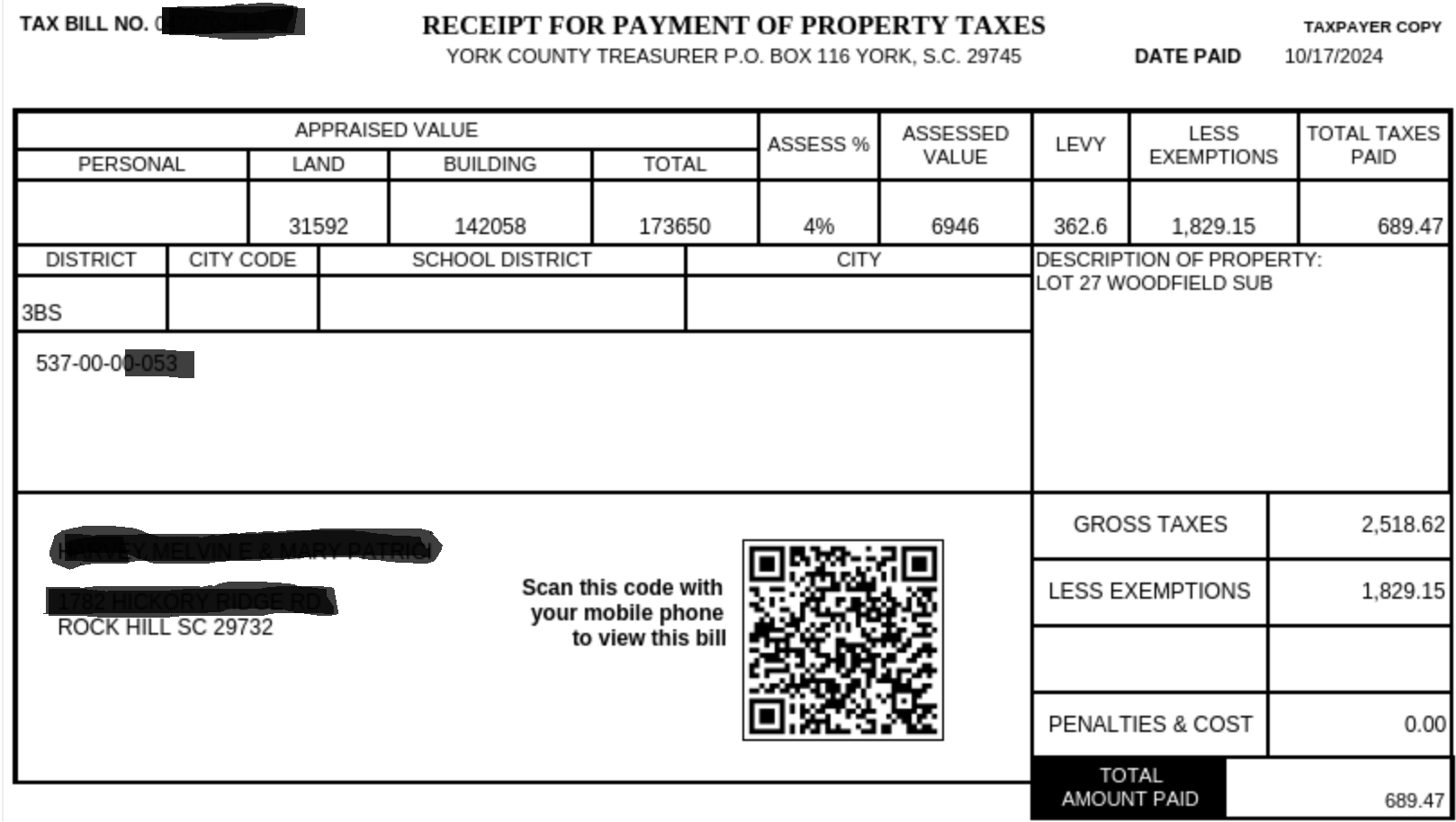
The property had an appraised value of $173,650 and was assessed at the 4% legal residence rate:
$173,650 × 4% = $6,946 assessed value
Once the assessed value is determined, the applicable local millage rates are used to calculate the gross property taxes.
In simplified form, the calculation looks like this:
Appraised Value × Assessment Ratio × Millage Rate = Gross Property Taxes
For this property:
$173,650 × 4% × 0.3626 = $2,518.62 in gross taxes
Because this was the owner's primary residence, the property qualified for the school operating tax exemption.
The homeowner was also over age 65 and qualified for South Carolina's Homestead Exemption. At the time of this 2024 tax bill, that exemption removed the first $50,000 of the qualifying primary residence's fair market value from applicable property taxes.
Together, the exemptions reduced the tax bill by $1,829.15, bringing the final bill down to just $689.47!
What Happened When the Home Became a Rental?
After we purchased the house and placed it into service as a rental property, the property tax bill changed considerably.
Here is the tax bill for the same property the following year:
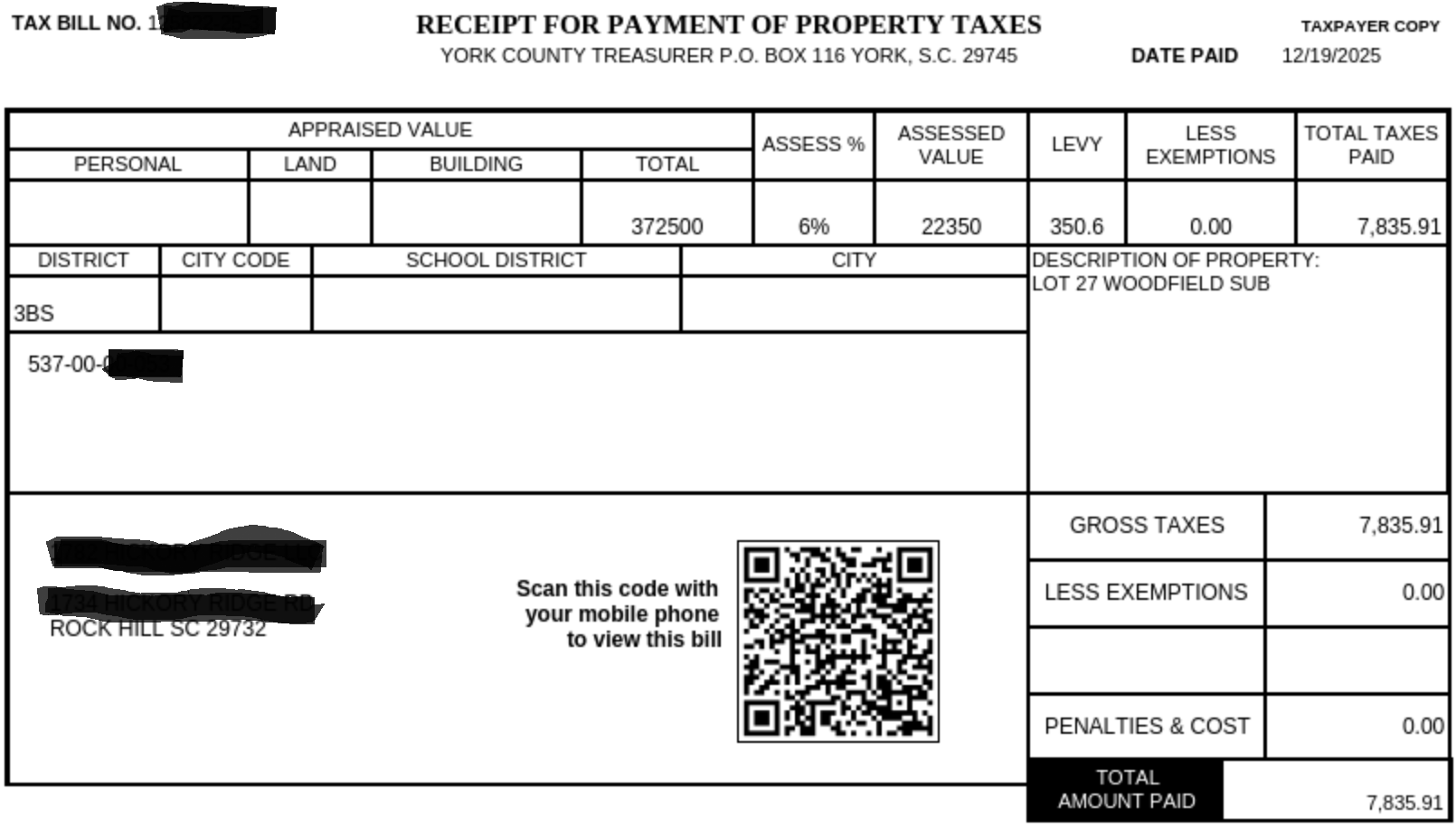
The bill increased from approximately $689 to $7,836 — more than 11 times the prior year's bill!
Why such a dramatic increase? Several things happened at once:
The property's taxable value increased significantly following the sale. A sale is generally considered an assessable transfer of interest (ATI) in South Carolina, which can trigger a new appraisal at fair market value. In this case, the new appraised value was more than double the previous value.
The assessment ratio increased from 4% to 6%. Mathematically, that's a 50% increase in the assessment ratio.
The school operating tax exemption was lost because the property was no longer being used as the owner's legal residence.
The Homestead Exemption was also lost because it applies to a qualifying owner's legal residence, not a rental property.
The millage rate actually decreased, which helped somewhat — but nowhere near enough to offset the other changes.
This example is more dramatic than most of the properties I evaluate because both the property's value and its tax treatment changed substantially at the same time. But it illustrates just how different the property tax bill can become once a South Carolina home is converted from a primary residence to a rental.
And that's why estimating property taxes is such an important part of determining whether renting your home makes financial sense and often one of the first things I discuss with prospective new landlords.
Now It's Your Turn
Want to estimate how your home's property taxes could change if you convert it to a rental? Here's a simple way to get started.
Step 1: Pull Up Your Current Property Tax Bill
Go to your county's property tax website and locate your most recently paid tax bill.
Here are links for several counties in our area:
Search using your property address and open the most recent tax bill.
Step 2: Find the Property's Appraised Value
Locate the appraised value or fair market value shown on the tax record.
Then estimate the assessed value at the 6% rate:
Appraised Value × 6% = Estimated Assessed Value
For example, if the appraised value is $400,000:
$400,000 × 6% = $24,000 assessed value
Important: Don't multiply the property's existing assessed value by 6%. You want to start with the appraised value.
Step 3: Apply the Millage Rate
Next, multiply the estimated assessed value by the applicable millage rate.
If the tax bill expresses the rate in mills, divide that number by 1,000 before multiplying.
For example:
352 mills ÷ 1,000 = 0.352
If the assessed value is $24,000:
$24,000 × 0.352 = $8,448
That provides a rough estimate of the gross property taxes before considering any applicable credits, fees, special assessments, or other adjustments.
And remember: once the property is no longer your legal residence, you should not assume that the exemptions appearing on your current owner-occupied tax bill will continue.
A Few Important Caveats
This method is useful for getting a ballpark estimate, but South Carolina property taxes aren't quite as simple as multiplying three numbers together.
Two additional factors can substantially affect your actual bill:
Countywide Reassessments
South Carolina counties periodically reassess real estate, generally on a five-year cycle. During a countywide reassessment, the fair market value assigned to your property may increase or decrease.
For most properties, increases resulting solely from a countywide reassessment are generally limited to 15% over the five-year reassessment cycle.
But here's an important distinction: that 15% limitation does not necessarily protect you when there has been an assessable transfer of interest, such as a sale. A sale can trigger a new appraisal at fair market value outside of the normal reassessment limitation.
Millage Rate Changes
Millage rates can also change from year to year.
Property taxes may include millage imposed by several different local taxing authorities, such as the county, municipality, school district, and other taxing districts. Those rates can change annually based on local budgets and other factors.
So even if your appraised value doesn't change, your final property tax bill may still be somewhat different from your estimate.
Not Financial or Tax Advice
This resource is intended to provide a general framework for estimating property taxes and is not financial, legal, or tax advice.
We always recommend that prospective rental property owners consult with an appropriate financial or tax professional who can evaluate their individual circumstances — particularly the tax implications of owning and operating rental real estate.
You may also find our article, Landlord Tax Questions: A Tax Professional Answers the Most Common Rental Property Tax Issues, helpful.
Need a Helping Hand?
Not great at math? Or just want a sanity check on the numbers you're seeing?
We're happy to help you work through the numbers and think through the other factors that should go into your decision about whether to rent your home.
Our goal isn't to convince every homeowner to become a landlord. It's to help you understand the numbers so you can make the decision that's best for you.
Reach out to me at jadamson@renttailored.com to schedule a time to talk.
About Tailored Homes Property Management
Tailored Homes Property Management provides hands-on property management services for medium- and long-term residential rental properties in Fort Mill, Tega Cay, Rock Hill, Lake Wylie, Lancaster, and surrounding South Carolina communities.
Learn more at RentTailored.com.